Nepalese vs. Indian Food: 5 Key Differences You Can Taste
If you’ve ever looked at a South Asian restaurant menu and thought Nepalese and Indian food are basically the same, you’re not alone. It’s a very common assumption.
Both cuisines use similar spices and are built around sharing food together. But when you actually taste them side by side, the differences quickly become clear.
This guide walks you through five key differences between Nepalese and Indian food you can actually taste, along with the dishes that best show them off.
Difference Between Nepalese and Indian Cuisine at a Glance
Before we get into the details, here’s the short version. Nepalese cuisine tends to be lighter, more herb-forward, and rooted in Himalayan simplicity. Indian cuisine is known for its richness, complex spice layering, and the bold, slow-cooked depth of its curries and tandoori dishes.
Both are deeply satisfying. Both have a strong street food culture. And both use many of the same base spices. The difference lies in how those spices are used, what they’re paired with, and the cooking traditions behind each dish.
Why Nepalese and Indian Food Are Often Compared
It makes sense that people group them together. Nepal shares a long border with India, and centuries of trade, migration, and cultural exchange have left their mark on both kitchens.
Cumin, turmeric, ginger, garlic, and coriander appear in both cuisines. Many restaurants in the UK also serve both traditions on the same menu, which reinforces the idea that they’re interchangeable.
But geography and shared ingredients only tell part of the story. Nepal also borders Tibet and sits at the foot of the Himalayas, which has shaped its cuisine in completely different ways. The result is a food culture that feels distinct from Indian cooking once you actually taste it.
If you’re new to Nepalese food and want to understand it from the ground up, our guide to Nepalese cuisine for beginners is a good place to start.
Nepalese vs Indian Food: Key Differences in Taste and Cooking
The simplest way to describe the difference is this: Nepalese food is ingredient-led, while Indian food is sauce-led. Nepalese dishes tend to let the natural flavours of meat, vegetables, and lentils come through with spices playing a supporting role.
Indian cooking, particularly its curries and marinades, builds flavour through layering and long cooking times.
That said, both cuisines have incredible range. Neither can be reduced to a single style. What follows are five differences that consistently show up when you compare the two.
1. Dumplings vs Fried Snacks
This is probably the most obvious difference, and the one most people notice first.
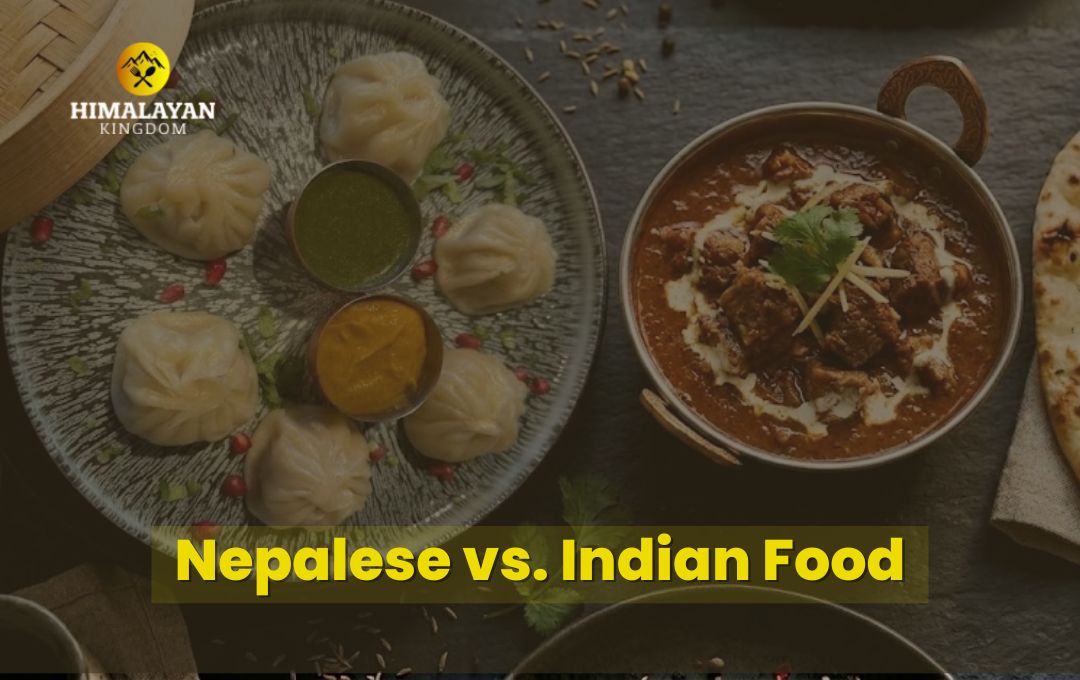
Nepalese cuisine is built around the momo. These steamed dumplings are filled with spiced meat or vegetables, folded by hand, and cooked until soft and juicy. They’re served with a dipping sauce that’s usually tangy, spicy, and sharp all at once.
Veg Steam Momo, Chicken Steam Momo, and Chicken Jhol Momo (served in a rich, spiced broth) are all perfect examples of how central dumplings are to Nepalese food culture.
Indian starters go in a very different direction. Onion Bhaji, Aloo Tikki, and homemade Samosas are all about the fry. Crispy on the outside, warmly spiced inside, and deeply rooted in the street food tradition that runs through Indian cooking.
The textures and cooking methods are completely different from a delicate steamed momo. To see what great momos actually look and taste like, our piece on the best momo in Altrincham goes into the details.
2. Fresh Himalayan Flavours vs Indian Chaat
Street food is where both cuisines reveal their personalities most clearly, and the contrast here is striking.
Nepalese street food is fresh, punchy, and direct. Dishes like Nepali Chatpat and Avocado Chatpate are tangy and spicy with a herb-forward quality that feels light and vivid.
There’s less reliance on cooked-down chutneys and more emphasis on raw, bright ingredients that hit your palate immediately.
Indian chaat does something very different. Papadi Chaat, Pani Puri, Bhel Puri, and Dahi Puri are all about layering contrasting flavours into a single bite. Sweet tamarind chutney, sharp green chutney, cool yoghurt, crunchy fried dough, and a kick of chilli all land at once.
The effect is genuinely complex, and it’s a style of eating that’s hard to find anywhere else in the world.
Neither approach is superior. They’re just different philosophies about what street food should do.
3. Himalayan Grills vs Tandoori Cooking
Both cuisines grill brilliantly, but the techniques and flavour profiles are very different.
Nepalese grilled food is rustic and fiery. Chicken Choila, a traditional Newari dish, sees chicken chargrilled and then tossed with mustard oil, green chilli, ginger, and garlic. The result is smoky, spicy, and intensely flavoured without any heavy marinade getting in the way.
Lamb Chops and Tareko Seabass follow a similar approach: let the fire and a handful of bold seasonings carry the dish.
Indian tandoori cooking is all about the marinade. Chicken Tikka, Paneer Tikka, and Tandoori Chicken are prepared by marinating the protein in spiced yoghurt for several hours before cooking in a clay tandoor oven at very high heat.
The yoghurt tenderises the meat and creates that distinctive charred exterior with a soft, aromatic centre. Seek Kebab works similarly, with minced meat on skewers cooked over direct heat.
For a closer look at how tandoori techniques create standout results, our piece on the best tandoori chicken in Altrincham is worth reading.
4. Lighter Himalayan Meals vs Rich Indian Curries
This difference becomes most obvious when you order a full main course.
Nepalese main dishes are built around balance rather than richness. A Nepalese Chicken Thali or Lamb Thali brings together lentil soup, rice, a curry, pickles, and seasonal vegetables, each element playing a specific role.
The Mustang Lamb Curry and Nepali Fish Curry use spices carefully, but the sauces stay lighter, letting the quality of the ingredients speak for themselves. Eating a Nepalese thali feels nourishing and grounding rather than heavy.
Indian curries are famous for exactly the opposite. Butter Chicken gets its depth from tomatoes, cream, and slow-cooked spices. Lamb Rogan Josh builds complexity through a lengthy cooking process.
Chicken Tikka Masala delivers smoky grilled chicken in a thick, indulgent sauce. Dal Makhani simmers overnight to reach its signature velvety consistency. These dishes are unapologetically rich, and that richness is the point.
If you’re still getting to know Indian cuisine, our guide to Indian cuisine for beginners offers a helpful overview of the key dishes and flavour profiles to know.
5. Dumpling Culture vs Bread and Curry Pairings
The final difference shows up in how each cuisine structures the act of eating itself.
In Nepalese dining, momos often function as a complete dish on their own. Veg Steam Momo, Chicken Fried Momo, and Veg Jhol Momo can each be ordered as a starter or as a satisfying main. They come with dipping sauces, not bread, and the experience is self-contained.
Dumplings are also a social food in Nepal: something you make together, share around a table, and eat in generous quantities.
In Indian dining, bread is foundational. Garlic Naan, Peshwari Naan, Tandoori Roti, and Lachha Paratha aren’t just sides. They’re the vehicle through which you eat the curry, scoop up the dal, and experience the meal. The relationship between bread and curry is so central to Indian food that eating one without the other feels incomplete.
Popular Nepalese and Indian Dishes You Should Try
If you want to taste these differences for yourself, here are some dishes worth putting on your list.
For Nepalese food, start with a plate of Chicken Steam Momo or Chicken Jhol Momo to understand the dumpling tradition. Follow that with Chicken Choila for the smoky, chilli-forward grill style, and finish with a Nepalese Lamb Thali to see how a full Himalayan meal comes together. Nepali Chatpat is also worth trying if you want to experience Nepalese street flavours at their most vibrant.
For Indian food, Papadi Chaat or Pani Puri give you a proper introduction to the chaat tradition. Chicken Tikka Masala and Lamb Rogan Josh show off the richness of Indian curry cooking, while Garlic Naan or Lachha Paratha complete the experience. And if you haven’t tried a great Biryani yet, our guide to the best Biryani in Altrincham is a great starting point.
Where to Experience Authentic Nepalese and Indian Food
The good news is you don’t have to choose between the two. Some restaurants bring both traditions to the same menu, letting you explore momos alongside Butter Chicken, or a Nepalese Thali next to Garlic Naan and Rogan Josh.
It’s actually one of the most enjoyable ways to understand both cuisines: tasting them side by side makes the differences far more obvious than any description can.
If you’re based in or visiting the nearby area from Altrincham, Himalayan Kingdom at Hale can give you the authentic taste of both Nepalese and Indian cuisine.
Conclusion
Nepalese and Indian food share deep roots, but they’ve grown into genuinely distinct cuisines with their own identities, techniques, and flavour philosophies. From the soft, juicy momo to the rich depths of a Lamb Rogan Josh; from the fresh punch of Chatpate to the layered complexity of Papadi Chaat; each tradition offers something the other simply doesn’t replicate.
If you’ve only ever experienced one, you’re missing half the picture. And if Nepalese food is still new to you, it’s worth approaching it with curiosity rather than comparison. It stands very comfortably on its own terms.
FAQs
Is Nepalese food spicier than Indian food?
Not necessarily. Both cuisines use chilli, but Nepalese food often channels heat through fresh chillies and mustard oil rather than spice blends. Indian food can range from very mild (like Butter Chicken) to intensely hot, depending on the dish and region.
Do Nepalese and Indian restaurants serve the same dishes?
Some overlap exists, particularly with rice dishes and certain curries. But signature Nepalese dishes like momos, Choila, and Dal Bhat are distinct, just as Indian dishes like Biryani, Tikka Masala, and Chaat are specific to that tradition.
Is Nepalese food vegetarian-friendly?
Yes. Nepalese cuisine has a strong tradition of vegetarian cooking, with dishes like Veg Steam Momo, lentil-based Dal, and seasonal vegetable curries. Indian cuisine is similarly rich in vegetarian options.
What is the most iconic Nepalese dish?
Momos are probably the most recognised Nepalese dish internationally. Dal Bhat, a combination of lentil soup, rice, and accompaniments, is the everyday national staple in Nepal.
Where can I try authentic Nepalese and Indian food in Altrincham?
You can explore authentic Nepalese and Indian cuisine in the UK at restaurants inspired by the Himalayan Kingdom. Look for places that serve traditional Nepalese dishes such as Jhol Momo and Choila, alongside Indian classics, using high-quality ingredients sourced with care.