What is a Nepali Thali? Everything You Need to Know Before You Order
You walk into a Nepali restaurant, and the menu has all the usual dishes: momos, thukpa, and a handful of curries and then this one item: Nepali Thali.
It’s listed differently from everything else, almost like its own category, and if you’ve never ordered one before, it’s worth knowing exactly what you’re getting into.
A Nepali thali is a complete meal served on one plate, bringing together steamed rice, lentil soup (dal), a curry, pickles (achar), and greens, all placed together and eaten at once rather than arriving as separate courses. It’s not a starter you order to hold you over, and it’s not a side dish sitting next to something bigger. It stands on its own as the whole meal.
For most Nepali families, this isn’t a once-in-a-while treat. It’s simply what’s eaten at home, day after day, often more than once. That everyday familiarity is part of what makes it feel so genuine when you order it at a restaurant: you’re not getting a special “authentic experience” version. You’re getting the real thing, the way it’s actually eaten.
Let’s get into what makes it so special, what it costs, and where to find a proper one right here in Altrincham.
What Exactly Is a Nepali Thali?
“Thali” simply means plate. But a Nepali thali isn’t just any plate. It’s everything served together-rice, dal, curry, and sides-all arriving at once instead of one dish after another. A few things set it apart:
● Everything comes together, not course by course
● You’re meant to mix it: a bite of rice, a bit of dal, a touch of achar
● It’s not a restaurant invention.
It’s what Nepali families eat at home every day. That last point matters more than people realize. A Nepali thali isn’t dressed up for show. It’s just how the meal has always been served.
Where does Nepali Thali Come From: A Tradition Built on Balance
Nepal sits between India and Tibet, high in the Himalayas. Its food carries traces of both, but it’s never just a copy of either.
Nepali food culture is built on a few simple ideas:
● Balance over heat. Flavor over fire.
● Rice and lentils, the foundation, day after day.
● Vegetables and pickles aren’t extras. They’re essential.
● Meals in Nepal are often a family affair.
Sharing food around one table is part of everyday life, and the thali reflects this tradition by bringing together a variety of dishes for everyone to enjoy.
That’s why a thali feels different from a typical takeaway curry. It’s not built to impress but to feed you properly. If you’re curious how this compares to food you already know, our guide on Nepalese vs. Indian food breaks down where the two cuisines part ways. To understand Nepali cuisine at its most honest, this is the plate to start with.
Which Nepali Thali Should You Order: Chicken, Vegetable, or Lamb?
Once you’ve decided to try a thali, the next step is picking your protein. At Himalayan Kingdom, every thali shares the same foundation: poppadom, salad, gundruk, tomato achar, Nepali daal, mixed vegetables, saag, curd, and gulab jamun. The only difference is the curry in the middle of the plate.
Chicken Thali
The popular order on the menu is normally the right place to start. The chicken curry is mild and comforting rather than fiery, making it an easy first step into Nepali curry if you’re not used to the spices.
● Mild, beginner-friendly curry
● Pairs well with the tang of the achar and the coolness of the curd
If you’re not sure where to begin, start here.
Vegetable Thali
Don’t think of this as the “meat-free version.” Think of it as its own thing. The vegetable curry is a mix of seasonal vegetables simmered until they take on the same warming spice base, as the rest of the menu. It’s lighter than the chicken or lamb but not thin: the vegetables hold their texture, and the spicing does the heavy lifting instead of the meat.
● A proper, satisfying plate of vegetarian Nepali food
● Texture-forward rather than sauce-heavy. The vegetables are the star, not a filler
Nothing about this thali feels like a compromise.
Lamb Thali
For anyone who knows what they like. The lamb curry is deeper, richer, and a little bolder than the chicken version, designed for those people who want more weight behind their Nepali curry.
● Richer, more layered spice
● A favorite among regulars: If you’ve had the chicken thali and want to go further, this is the natural next step.
No matter which one you pick, you get the full plate every time.
Craving One Already?
Already know which thali you want? No need to read on, reserve your table now, or order ahead for collection.
Dal Bhat Tarkari: The Heart of Every Thali
Break the phrase down, and it’s simple.
- Dal: a thin, seasoned lentil soup, usually made from split lentils simmered with garlic, ginger, turmeric, and a few whole spices. It’s light, but it carries a lot of flavor for something so simple.
- Bhat: steamed rice, plain on its own, but it’s the base that soaks up everything else on the plate: the curry, the dal, and the achar.
- Tarkari: a vegetable curry, usually made with whatever’s in season, cooked down with warming spices until it’s soft and well-flavored rather than watery or bland.
Dal, bhat, and tarkari are the base that every thali is built on. Think of it like rice and beans elsewhere in the world. Plain in theory. Never actually boring, because the flavors carry it every time. For the full story on why this combination anchors Nepali cooking, read our piece on why dal bhat is Nepal’s most loved meal.
What’s Included in a Nepali Thali
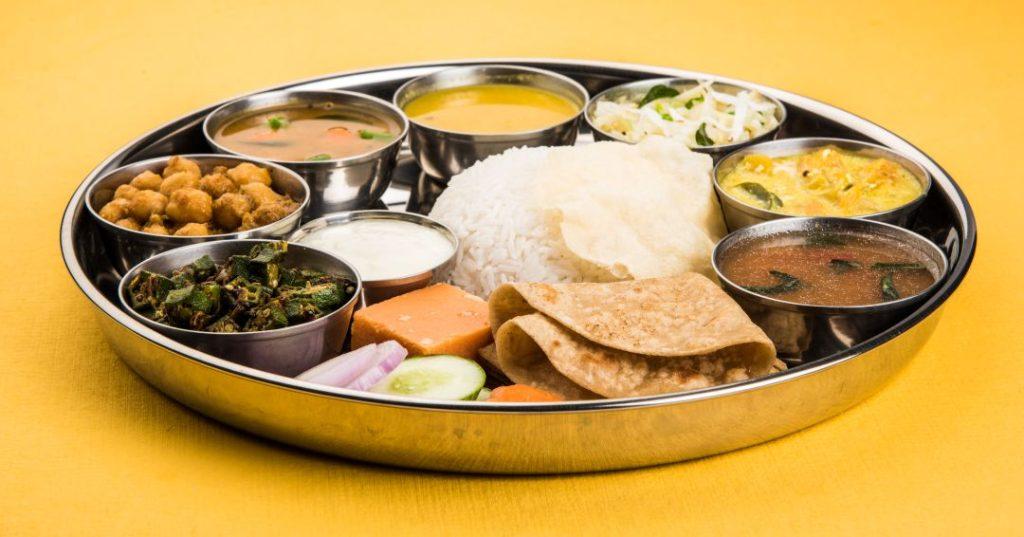
A Nepali thali includes:
- Poppadom: The thin, crispy disc that arrives at the start. Simple but effective, it gives you something crunchy to break up the softer textures of rice, dal, and curry before the main flavors begin.
- Fresh salad: A small side of raw, crunchy vegetables, usually onion, cucumber, and tomato. Nothing fancy, but it cuts through the richness of the curry and resets your palate between bites.
- Nepali achar (gundruk): A fermented leafy green with a sharp, tangy bite, unlike anything you’d find on an Indian menu. Made by fermenting mustard greens or radish leaves, it’s one of the few dishes on the plate that’s purely, distinctly Nepali.
- Tomato achar: The second pickle on the plate, tangy, sometimes spicy, and meant to be added a little at a time. Alongside the gundruk, these two pickles do more work than people expect; a small spoonful changes the whole bite.
- Nepali daal: A thin, well-seasoned lentil soup and the backbone of the entire meal. It’s what ties the rice, curry, and greens together into something that actually feels like a complete dish.
- Mixed vegetable: A warm side of seasonal vegetables, cooked in the same base of spices as the rest of the plate. It adds bulk and variety without competing with the main curry for attention.
- A curry (chicken, lamb, or vegetable): This is the centerpiece of the thali and the one part of the plate that changes depending on what you order. Everything else stays the same around it.
- Saag: Spinach or seasonal greens, cooked down and lightly spiced. Simple, earthy, and a good contrast to the richer curry sitting next to it.
- Curd: Cool, thick, and slightly tangy. It’s there to calm things down if the curry or achar gets too spicy – a built-in reset button.
- Gulab jamun: A small, syrupy sweet that shows up right at the end. Warm, soft, and just the right amount – enough to finish things off on a sweet note without making you feel stuffed after everything else you’ve eaten.
If you want to build a bigger spread around your thali, our guide on what to order at a Nepalese restaurant covers momo, thukpa, and mains worth adding to the table.
How to Eat a Nepali Thali
There’s no strict rulebook. But here’s how it’s traditionally done:
- A small bite of rice, mixed with dal.
- Add a little curry, then a touch of achar.
- Yogurt when things get too spicy.
- Change the combination with almost every bite.
- Finish with the sweet if there’s one left. Traditionally, it’s eaten with the right hand.
Many believe it makes the food taste better, closer to the texture, temperature, and whole experience. Cutlery works just fine, too. There’s no wrong way to enjoy it.
How Much Does a Nepali Thali Cost?
A Nepali thali is priced as a full meal, not a side, since it includes curry, rice, dal, sides, and dessert in one order. At Himalayan Kingdom, thali prices are in the same range as a standard main course.
The Chicken and Vegetable Thali sit at £25.95 and £24.95, while the Lamb Thali is priced slightly higher at £27.95, reflecting the richer cut of meat
Check the full menu for current prices or call ahead if you’re planning a group order.
Try the Best Nepali thali in Hale, Altrincham
Reading about a thali is one thing. Sitting down to one, steam still rising off the rice, achar hitting your tongue first, gundruk cutting sharply through the richness of the curry, is something else entirely. If you’re searching for a Nepali restaurant near me and want to try a proper Nepali thali, Himalayan Kingdom in Hale, Altrincham, is the place to start. Every thali is made fresh, using traditional recipes and real Himalayan spices. If you’re still deciding where to eat, our guide to the best Nepalese restaurant in Altrincham covers what else makes us worth a visit.
● Try the chicken, vegetable, or lamb, all freshly prepared to order
● The same full set, every time: gundruk, achar, daal, saag, sweet
● A kitchen that treats authentic Nepali food as the everyday standard, not a special occasion.
The story of a Nepali thali is only partially conveyed by reading about it. When you smell fresh rice, dal, and homemade achar at your table, the true experience begins. Make a reservation order today.
Curious about South Indian flavours too? Don’t miss our guide to dosa, another dish worth trying on your next visit.
Follow Himalayan Kingdom on social media channels such as Facebook, Instagram, YouTube, and TikTok for the latest updates and news.
Frequently Asked Questions
1. What is a Nepali Thali?
A Nepali thali is a full traditional meal presented on a single platter. It typically brings together rice, dal (lentil soup), a vegetable or meat curry, achar (pickle), and leafy greens – all served at once so everything is enjoyed together instead of in separate courses.
2. What is the difference between a Nepali Thali and a Thakali Thali?
The Thakali thali is a distinctive regional style of Nepali thali originating from Nepal’s Mustang region, characterized by unique spices and cooking techniques. In contrast, a standard Nepali thali represents a balanced meal concept but is not specific to any single region.
3. What is the difference between Nepali and Indian Thali?
A Nepali thali tends to be lighter and lets the natural flavors of rice, dal, and vegetables come through, while an Indian thali is usually richer, with more layered spices and creamy, dairy-based curries.
4. Is Nepali Thali vegetarian or non-vegetarian?
A Nepali thali can be fully vegetarian. Most restaurants, including Himalayan Kingdom, offer a vegetarian thali that replaces the meat curry with a vegetable curry while keeping every other element of the plate the same.
5. Can I order a Nepali Thali for takeaway or delivery?
Yes. Himalayan Kingdom offers takeaway and delivery on its thali sets across Altrincham, so you can get the full plate at home if you’d rather not dine in.